

The Journal
Lab Grown Emerald vs Natural Emerald: price, how it is made, and how to tell them apart
What a laboratory-grown emerald is, how it compares with natural Colombian and Zambian emerald on price, clarity and durability, and how to tell them apart.
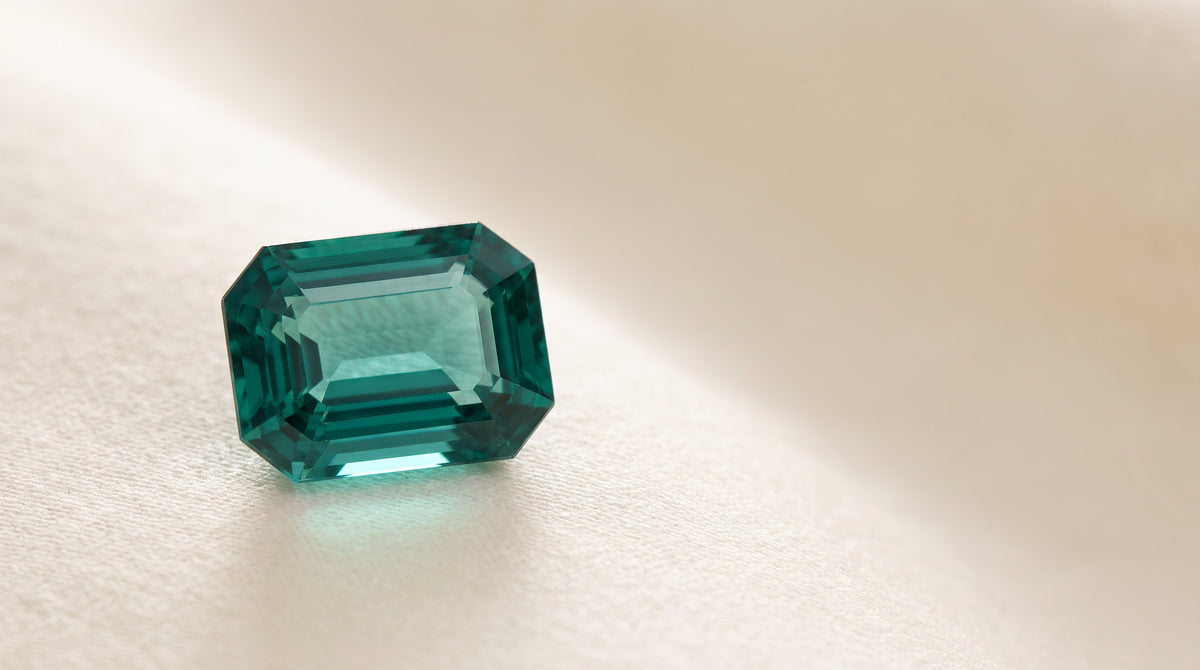
By Team Diamos — South Delhi gemstone and lab-grown diamond house since 2002. Prices checked 5 November 2026.
Short answer: a laboratory-grown emerald is real beryl, the same mineral as a mined Colombian emerald, grown in a few months instead of millions of years. It costs about ₹11,500 per carat at Diamos against ₹20,000 to several lakh per carat for comparable natural stones, and it has far fewer of the fractures that make natural emerald fragile. Here is how it is made, how it compares with natural and with the "Zambian vs Colombian" question, how to tell them apart, and what we think about panna and astrology.
What is a lab-grown emerald?
Emerald is beryl (beryllium aluminium silicate) coloured green by chromium and sometimes vanadium. A laboratory-grown emerald is the same crystal grown by the hydrothermal method: a seed of beryl is placed in a sealed vessel with a solution of the same elements, heated and pressurised, and the crystal grows on the seed layer by layer over several months. The older flux method grows it from a molten salt instead. Both produce beryl that is chemically and optically emerald; gem laboratories report it as "synthetic emerald" or "laboratory-grown emerald". Lab-grown emerald has been made since the 1930s; Diamos has sold it since 2002, which is where the company began.
Lab-grown vs natural emerald
| Laboratory-grown emerald | Natural emerald | |
|---|---|---|
| Mineral | Beryl, Cr-coloured | Beryl, Cr/V-coloured |
| Hardness | 7.5–8 | 7.5–8 |
| Inclusions | Few; small growth features | "Jardin" of fractures and inclusions in nearly every stone |
| Treatment | None | Almost always oiled or resin-filled to hide fractures |
| Durability in a ring | Good | Fragile; fractures can open with knocks or heat |
| Price per carat (India, 2026) | ≈ ₹11,500 (Diamos) | ₹20,000 – ₹5,00,000+ depending on origin, colour, clarity and oil |
| Rarity | None | High for clean, vivid stones |
The honest summary: if you want the mineral emerald, its colour and its hardness, a lab-grown stone gives you a cleaner, tougher version for a fraction of the price. If you want rarity and natural origin, buy natural, and budget for the oiling it will almost certainly carry.
"Lab-grown Colombian emerald": what the phrase means
Colombian emeralds (Muzo, Chivor, Coscuez) are prized for a slightly bluish, saturated green with a soft glow. Hydrothermal lab-grown emeralds are usually grown to match that colour, which is why they are sold as "Colombian colour" or, loosely, "lab-grown Colombian emerald". The stone is not from Colombia; it is grown to the Colombian standard. Zambian natural emeralds, by contrast, tend to be a cooler, more bluish green with better clarity than Colombian and are priced a little lower; more on lab-grown Colombian emeralds here.
Emerald price in India (2026)
| Grade | Typical price per carat |
|---|---|
| Commercial natural (Zambian/Brazilian, heavily oiled, included) | ₹5,000 – ₹20,000 |
| Good natural (Zambian, minor oil, eye-clean) | ₹40,000 – ₹1,50,000 |
| Fine natural Colombian (minor oil, vivid, certified) | ₹2,00,000 – ₹10,00,000+ |
| Laboratory-grown (Diamos) | ≈ ₹11,500 |
Natural figures are market ranges, not Diamos prices. Our lab-grown stock runs from a 1.40 ct pear at ₹16,100 to a 10.27 ct octagon at ₹1,18,105 (November 2026).
How to tell a lab-grown emerald from a natural one
You cannot by eye, and that is the point: the colour is the same. Under a 10x loupe a gemmologist looks for the "jardin" of three-phase inclusions, fractures and oil that natural emeralds carry, and in hydrothermal stones for chevron or wavy growth zoning and tiny nail-head spicules. For certainty, send it to a laboratory; Diamos sells every stone with a certificate stating laboratory-grown origin, and will never describe one as natural.
Panna and astrology
Emerald (panna) is the stone of Mercury (Budh) in Vedic astrology, traditionally worn on the little finger in gold or silver. Whether a laboratory-grown panna is acceptable for astrological wear is a question for your astrologer; some accept it because the mineral is identical, some do not. We make no claims either way and will show you the stone on its merits as a gem.
Caring for an emerald
Lab-grown emerald is tougher than natural because it lacks the fractures, but it is still beryl at 7.5–8: avoid ultrasonic cleaners and steam, take rings off for gym and housework, and clean with warm soapy water and a soft brush. Choose a bezel or a protective four-prong setting for daily-wear rings.
Buying emeralds in South Delhi
Diamos began in 2002 cutting and selling laboratory-grown emeralds in Chittaranjan Park, and still keeps the largest lab-grown emerald stock in Delhi: 60-plus stones from 1.4 to 11 ct in octagon, oval, pear and cabochon, set to order in 14K or 18K gold. Five minutes from Nehru Enclave and Nehru Place metro, parking at the store, closed Tuesdays. See the emerald stock or plan a visit.
Frequently asked questions
Is a lab-grown emerald a real emerald?
Yes. It is beryl coloured by chromium, the same mineral as natural emerald, with the same hardness and colour. Laboratories report it as laboratory-grown or synthetic emerald.
What is the price of lab-grown emerald per carat in India?
About ₹11,500 per carat at Diamos in November 2026, for vivid Colombian-colour stones with no treatment. Natural emerald of comparable colour runs from ₹40,000 to several lakh per carat.
Which is better, Zambian or Colombian emerald?
Colombian stones are prized for a warmer, glowing green; Zambian for a cooler bluish green and better clarity at lower prices. A lab-grown emerald is grown to Colombian colour with Zambian-or-better clarity.
Does a lab-grown emerald need oiling?
No. It has no fractures to fill, so it is sold untreated and never needs re-oiling, unlike most natural emeralds.
Can I see lab-grown emeralds in person in Delhi?
Yes, at the Diamos showroom, K-1/48, Lower Ground Floor, Chittaranjan Park, South Delhi, near Nehru Enclave metro, with parking at the store. Open Wednesday to Monday, 11 am to 8 pm.
From the house of Diamos, New Delhi.
Next in the journal
Blue Sapphire (Neelam) Price in India 2026: natural vs lab-grown, and what to check before buying

- ShopThe Diamos editMade to order, finished by hand, with its IGI report.Browse the jewellery
- Custom designMade only for youBegin with a sketch, a stone or a memory, and we will make it.Begin a commission
- The JournalEvery storyLab-grown and mined, moissanite and emerald, and choosing well.Back to the journal